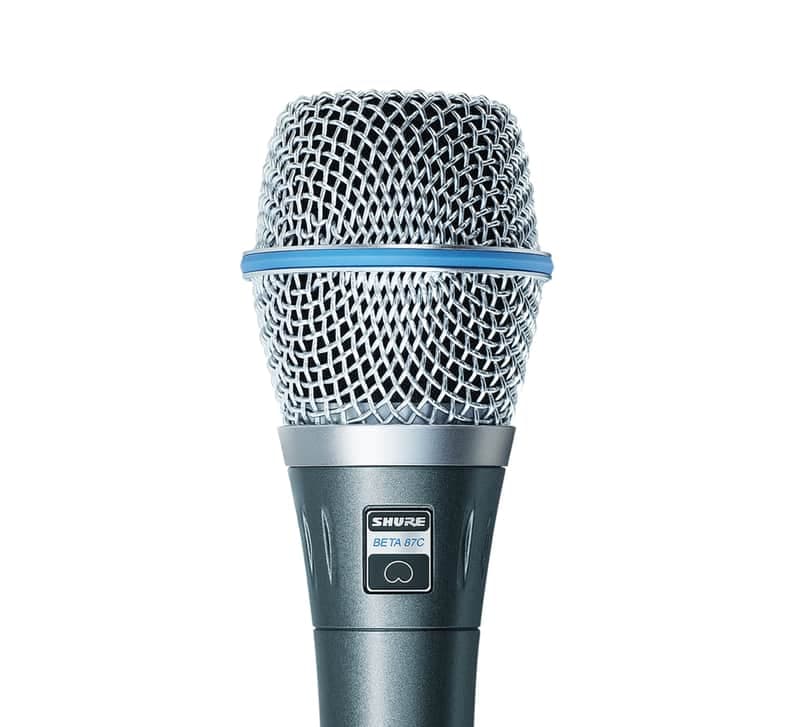
Shure BETA87C Cardioid Condenser Microphone for Handheld Vocal (open box) is a used item in mint condition, listed on Reverb. The asking price is £221. It is offered by Tone Tailors through Reverb. Local pickup is available. It is in our Microphones category. 24 similar listings have a median asking price of £184. Used Gear Hunter first saw this listing on 28 September 2026 and last saw it on 26 November 2026. It has been seen 63 times in our scans. Prices are converted from the seller's currency when we scan the listing, so the amount you pay may differ slightly. The seller sets shipping, and import duty or VAT may apply, so check the final cost and the item's details on Reverb before buying.
From the seller
BETA87CVocal Microphone
General Description
The Shure Beta 87C vocal microphone is precision-engineered to deliver an extremely smooth, extended high-end frequency response in a cardioid condenser design. The warm, natural sound creates an ideal environment for personal monitoring with excellent rear rejection.
An advanced, cartridge shock mount system, hardened steel-mesh grille, and superior build quality withstand the rigors of daily touring and sound reinforcement.
Features
Premier live performance microphone with Shure quality, ruggedness, and reliability
Uniform cardioid pick-up pattern for maximum gain before feedback and excellent rejection of off-axis sound
Smooth, wide frequency response with slight presence rise and controlled proximity effect tailored for vocals
Advanced cartridge shock mount system absorbs mechanical shock and minimizes handling noise
Very low susceptibility to RF and electromagnetic hum
Dent-resistant steel mesh grille and enamel coated metal alloy construction resist wear and abuse
Effective built-in pop filter reduces undesirable wind and breath noise
Applications
General Rules for Use
Do not cover any part of the microphone grille with your hand, as this will adversely affect microphone performance.
Aim the microphone toward the desired sound source (such as the talker, singer, or instrument) and away from unwanted sources.
Place the microphone as close as practical to the desired sound source.
Work close to the microphone for extra bass response.
Use only one microphone to pick up a single sound source.
For better gain before feedback, use fewer microphones.
Keep the distance between microphones at least three times the distance from each microphone to its source (“three to one rule”).
Place microphones as far as possible from reflective surfaces.
Add a windscreen when using the microphone outdoors.
Avoid excessive handling to minimize pickup of mechanical noise and vibration.
Applications And Placement
The following table lists the most common applications and placement techniques. Keep in mind that microphone technique is largely a matter of personal taste; there is no one “correct” microphone position.
Application
Suggested Microphone Placement
Tone Quality
Vocals
Lips less than 15 cm (6 in.) away or touching the windscreen, on axis to microphone.
Robust sound, emphasized bass, maximum isolation from other sources.
15 to 60 cm (6 in. to 2 ft.) away from mouth, just above nose height.
Natural sound, reduced bass.
20 to 60 cm (8 in. to 2 ft.) away from mouth, slightly off to one side.
Natural sound, reduced bass and minimal “s” sounds.
90 cm to 1.8 m (3 to 6 ft.) away.
Thinner, distant sound; noticeable levels of ambient noise.
Avoiding Pickup of Unwanted Sound Sources
Place the microphone so that unwanted sound sources, such as monitors and loudspeakers, are directly behind it. To minimize feedback and ensure optimum rejection of unwanted sound, always test microphone placement before a performance.
Recommended Loudspeaker Locations for Cardioid Microphones
Proximity Effect
Unidirectional (cardioid) microphones progressively boost bass frequencies by 6 to 10 dB below 100 Hz when the microphone is at a distance of about 6 mm (1/4 in.) from the sound source. This phenomenon, known as proximity effect, can be used to create a warmer, more powerful sound. To prevent explosive low frequency sound during close-up use, the bass response gradually rolls off. This provides greater control and helps the user take advantage of proximity effect.
Power Requirements
This microphone requires phantom power and performs best with a 48 Vdc supply (IEC-61938). However, it will operate with slightly decreased headroom and sensitivity with supplies as low as 11 Vdc.
Most modern mixers provide phantom power. You must use a balanced microphone cable: XLR-to-XLR or XLR-to-TRS.
Specifications
Type
Electret Condenser
Frequency Response
50 to 16,000 Hz
Polar Pattern
Cardioid
Output Impedance
EIA rated at150 Ω(100 Ωactual)
Sensitivity
at 1kHz,open circuit voltage
-51 dBV/Pa(2 mV)[1]
Maximum SPL
1 kHz at 1% THD,1 kΩ load
139 dB
Signal-to-Noise Ratio
70.5 dB[2]
Dynamic Range
at 1kHz,1 kΩ load
117 dB
Clipping Level
1 kHz at 0.25% THD,1 kΩ load
-6 dBV(0.5 V)
Self Noise
typical,equivalent SPL,A-weighted
22 dB
Hum Pickup
typical, at 60 Hz, equivalent SPL/mOe
-5 dB
Polarity
Positive pressure on diaphragm produces positive voltage on pin 2 with respect to pin 3
Weight
Packaged
0.565 kg(1.24 lbs)
Net
0.207 kg(0.475 lbs)
Connector
Three-pin professional audio (XLR), male, balanced
Housing
Aluminum construction with painted blue metallic finish, and hardened steel grille with nickel satin chrome plating
Power Requirements
11 to 52 V DCphantom power(1.2 mA)
[1] 1 Pa=94 dB SPL
[2] S/N ratio is difference between 94 dB SPL and equivalent SPL of self noise, A-weighted
Overall Dimensions
Typical Frequency Response
Typical Polar…