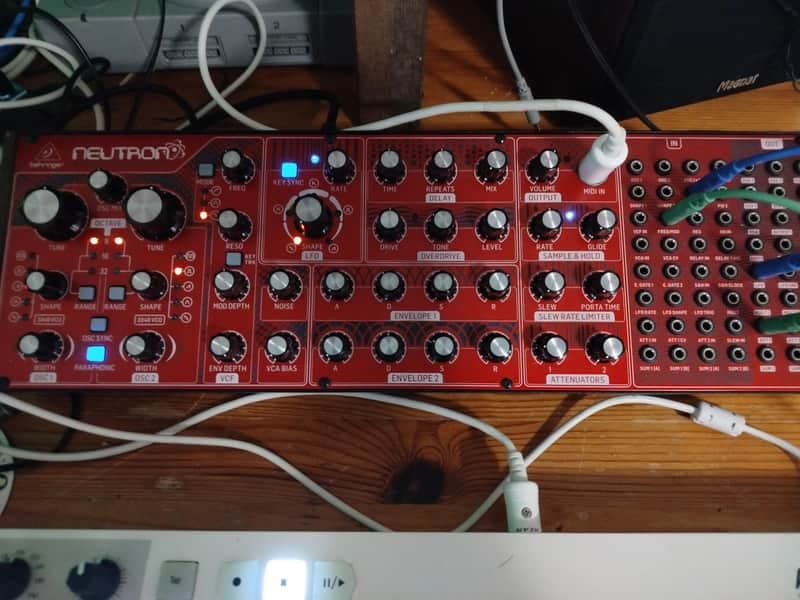
Behringer Neutron Paraphonic Analog & Semi-Modular Synthesizer 2018 - Red is a used item in excellent condition, listed on Reverb. The asking price is £244. It is offered by BWG through Reverb. It is in our Modular category. 18 similar listings have a median asking price of £189. Used Gear Hunter first saw this listing on 26 October 2026 and last saw it on 4 November 2026. It has been seen 2 times in our scans. Prices are converted from the seller's currency when we scan the listing, so the amount you pay may differ slightly. The seller sets shipping, and import duty or VAT may apply, so check the final cost and the item's details on Reverb before buying.
From the seller
The Behringer Neutron is a powerful, budget-friendly semi-modular paraphonic analog synthesizer designed in collaboration with Midas. It features an all-analog signal path paired with a robust 56-point patch bay, making it a favorite for desktop setups and a perfect entry point into Eurorack systems. [1, 2, 3]
Technical Specifications & Architecture
Parameter - Specifications
Synthesis TypePure analog subtractive
PolyphonyMonophonic with Paraphonic Mode (independent VCO control)
Oscillators (VCO)2 x custom 3340 analog oscillators (recreation of the classic CEM3340 chip)
Waveforms5 shapes: Sine, Triangle, Sawtooth, Pulse, and Tone Mod (with continuous morphing)
Filter (VCF)12 dB/Oct State Variable Filter (Lowpass, Highpass, Bandpass) with self-oscillation
Envelopes (EG)2 x Analog ADSR generators (default routed to VCF and VCA)LFO1 x Digital LFO with 5 shapes, MIDI clock sync, and Key sync
EffectsMulti-stage analog Bucket Brigade Delay (BBD) and an analog Overdrive circuit
Patch Bay56 points (32 inputs x 24 outputs) for custom routing and Eurorack integration
Form FactorDesktop chassis or can be removed to fit an 80 HP Eurorack case
Physical Size42.4 cm (Width) x 13.6 cm (Height) x 9.4 cm (Depth);
Key Features Explained
VCO Waveform Morphing: Rather than switching statically between waveforms, the continuous wave-shape controls allow you to seamlessly blend and morph across the five available shapes. [1, 2]
Semi-Modular "Normalled" Path: You do not need a single patch cable to make sound right out of the box. The default internal routing connects the VCOs to the filter, overdrive, delay, and VCA automatically. [1, 2, 3, 4]
Onboard Utility Modules: The right side of the unit includes useful utility tools for modular synthesis, including a Sample & Hold circuit with glide, two attenuators, a slew rate limiter, and a basic summing block. [1, 2, 3, 4, 5]
Connectivity Options: The rear panel hosts 1/4-inch main inputs and outputs, a dedicated headphone jack with volume control, standard 5-pin MIDI In/Thru ports, and a USB-B port for computer MIDI connection. [1, 2, 3]
Sound Design & User Consensus
Pros:
Aggressive and Fat Sound: Highly praised by users on platforms like Reddit's r/synthesizers community for its thumping low-end bass, grit, and screaming lead capabilities.
Incredible Value: Evaluated as one of the dense, highly accessible hardware synths for beginners trying to learn analog patching.
Eurorack Bridge: The onboard utility modules (like dual attenuators) save massive workspace and cost for Eurorack enthusiasts. [1, 2, 3, 4, 5]
Cons:
Noise Bleed: Some reviewers point out that the BBD delay circuit can introduce low-level background noise or artifact bleed even when turned down.
USB MIDI Ground Hum: Using the USB port for MIDI connections can sometimes introduce digital noise hum into the analog audio path. [1, 2, 3]