Back to Browse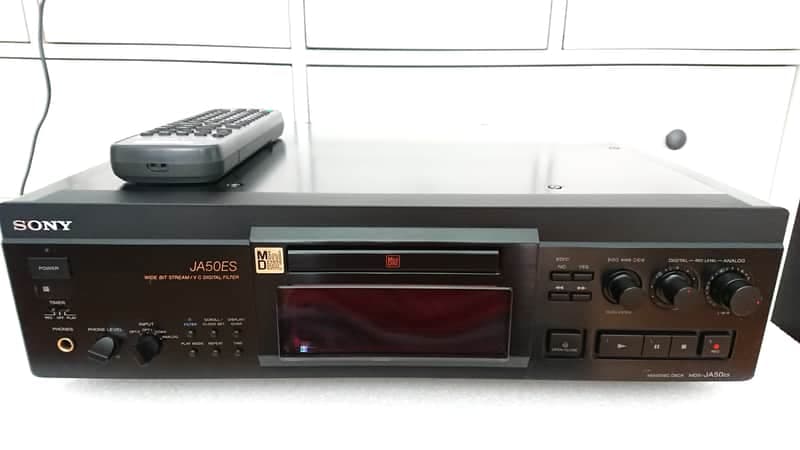
Sony Minidisc Deck MDS-JA50ES 1999 - Black
£2,609
Price dropped from £2,619
ExcellentReverb2mo ago
Sold by
P
Petronel 's Gear Locker
Details
- First Seen
- 28 September 2026
- Last Seen
- 27 November 2026
- Times Seen
- 65
About this listing
Sony Minidisc Deck MDS-JA50ES 1999 - Black is a used item in excellent condition, listed on Reverb. The asking price is £2,609. It is offered by Petronel 's Gear Locker through Reverb. It is in our Recorders & Tape category. Used Gear Hunter first saw this listing on 28 September 2026 and last saw it on 27 November 2026. It has been seen 65 times in our scans. Prices are converted from the seller's currency when we scan the listing, so the amount you pay may differ slightly. The seller sets shipping, and import duty or VAT may apply, so check the final cost and the item's details on Reverb before buying.
From the seller
SONY MDS-JA50ES
A prestige model of the ES series MD deck with DSP for ATRAC and wide bit stream technology.
In order to maximize the use of the ATRAC audio compression technology and to further improve sound quality, we have introduced a wide bit stream technology using a newly developed ATRAC DSP. This technology uses the new ATRAC DSP, which is the 4.5 generation, as a key device, with 20-bit input / output and 24-bit ( data) × 24-bit (coefficient) arithmetic operations.
The MDS-JA50ES divides the audio band into three blocks : low, medium, and high. Floating operation is performed for each block. The block with large data is left as it is, and the block with small data is operated by raising the level of each block. Thus, reproduction of low-order bits, which had been truncated in the past, is made possible, and reproducibility of minute level music signals is improved. This enables recording and playback with 20-bit accuracy and a wide dynamic range.
The A/D converter is equipped with a 24-bit delta-sigma (delta-sigma) A/D converter with high precision oversampling.
An adaptive high-frequency control technology has been introduced to improve the reproducibility of the high-frequency range and the sense of natural sound spread.
This algorithm was developed as an algorithm that effectively uses a limited amount of data by controlling the high-frequency range according to the input signal based on the human auditory sense. For example, with this algorithm, for signals containing regular frequency components, for which distortion is felt to be worse when the number of quantization bits is small, the quantization bits are limited to between about 15 kHz and 22.05 kHz to increase the quantization bits. On the other hand, for signals containing complex frequency components that are less affected by insufficient quantization bits, the reproduction band is extended to higher frequencies to improve the reproducibility of the high-frequency range.
By combining this adaptive high-frequency control technology with the expansion of the operational tone, the accuracy of signal processing has been improved, and the total harmonic distortion rate has been improved by approximately 8 dB compared with conventional methods.
It is equipped with a sampling rate converter that automatically converts 32 kHz and 48 kHz sampling 48 kHz to 44.1 kHz and enables digital recording with quality degradation.
The D/A converter uses the current pulse D/A converter used in Sony's ES series CD players. The current pulse output as voltage is replaced with a current that is less affected by voltage-induced noise and transmitted. It has a stable current source and is not affected by voltage fluctuations, enabling stable low-frequency playback.
The power supply section uses an R-core transformer with no breaks in the iron core of the transformer and a circular doughnut type section to reduce magnetic flux leakage and vibration.
BASC panel is used for the front panel. BASC is an acronym for B (Brass), A (Aluminum), S (Steel), and C (Construction). It pursues structural accuracy and eliminating resonance that cannot be achieved by combining molded parts.
In the case of molded parts, the points that can be fixed with screws are limited to a certain extent, and resonance remains. In addition, precision is also insufficient due to expansion and contraction when the parts are molded. On the other hand, metal parts can be processed with high precision, so high structural accuracy can be pursued. In addition, connecting points of parts can be installed at important points. In addition, by combining three types of metals with different natural frequencies, the effect of stopping vibrations from each other can be obtained.
The MDS-JA50ES has a steel base with a brass guide that is connected to an aluminum panel plate, and the volume and other parts are attached to the brass guide so that the face protrudes from the aluminum panel.
In addition, most of the volume knobs and buttons are made of aluminum.
FB chassis is adopted for the chassis. Metal material with sufficient strength and thickness is used. The whole chassis is firmly fixed as one box by surrounding brems and beams passed in front and back. By combining members of different shapes and sizes in each part, natural vibration is mutually cancelled, and vibration of the whole chassis is reduced.
In addition, the chassis of the mechanical deck is made of metal material with sufficient thickness. Strong metal is combined around the base unit to form a single shell, making the structure not only rigid but also resistant to vibration.
By using an eccentric insulator whose mounting hole to the chassis is offset from the center, signals transmitted from the outside are mutually canceled, making it difficult for signals to be transmitted to the chassis. As a result, it is effective in damping vibration components in the middle and high frequency range, which affect auditory sense in…