Back to Browse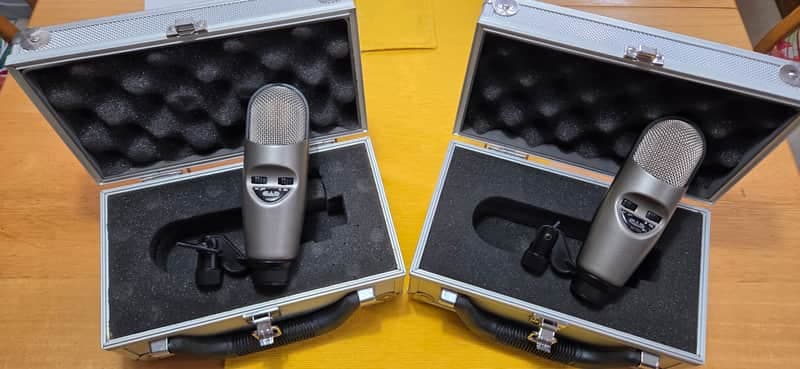
CAD M177 Matched Pair, Consecutive Serial Numbers *MODERNIZED*
£345
Very GoodReverb1mo ago
Sold by
U
Used Studio Electronics
Details
- First Seen
- 28 September 2026
- Last Seen
- 26 November 2026
- Times Seen
- 64
About this listing
CAD M177 Matched Pair, Consecutive Serial Numbers *MODERNIZED* is a used item in very good condition, listed on Reverb. The asking price is £345. It is offered by Used Studio Electronics through Reverb. It is in our Microphones category. Used Gear Hunter first saw this listing on 28 September 2026 and last saw it on 26 November 2026. It has been seen 64 times in our scans. Prices are converted from the seller's currency when we scan the listing, so the amount you pay may differ slightly. The seller sets shipping, and import duty or VAT may apply, so check the final cost and the item's details on Reverb before buying.
From the seller
This listing is for a MATCHED PAIR of CAD M177’s with consecutive serial numbers (#1578 and #1579). They have brass K67 capsules with rising high frequency response.
These mics from the early 2000’s have been modernized, they have received improved JFET input op amps on sockets (OPA1642a in place of the much older TLC072 they originally came with) so that any desired future changes with other low current dual JFET op amps can be easily made by someone who knows what they are doing, Wima film coupling capacitors (in place of the tantalums they originally came with), and Panasonic FR Series Low ESR power supply reservoir capacitors.
The CAD M Series and E Series op amp mics from this era are revered by some and totally misunderstood by others. They are *NOT* CHARACTER microphones that exhibit pleasant distortion. They are clean, “you are there” microphones that, when used with an equally clean preamp, render every bit of undistorted detail that the capsule within them is capable of producing. Most mics use a combination of discreet JFETS and bipolar transistors (and sometimes transformers) to generate the output signal. These CAD mics use ultra linear, low distortion op amps for both the impedance transformation and output phase splitting required.
Mics of this type absolutely excel in situations where you want to hear all of the grain, detail and transient clarity of the source. They make mind blowing drum overhead mics because of their ability to accurately render the “snap” of percussion instruments. They are also quite amazing when it comes to revealing the nuance of instruments like guitar, violin, piano, or anything where you need the clarity and naturalness of the instrument to shine through. Yes, they can be used on vocals too, but it just depends on the voice and characteristics of the singer, for the level of detail can make some voices sound harsh. As room mics, in various placements they are stunningly accurate and capture ambience remarkably realistically.
A caveat: The mics have spacious and unbridled low frequency response (down to 10Hz) which means that they need good isolation on a non-resonant stand, and there are a number of shock mounts that will work with these mics, sold separately. You will also note that, even in a good room and during moments of silence that there is strong subharmonic response which you will clearly see in your recording software. To deal with this, it is recommended to capture your audio, then as the very first step use a low rolloff/high pass filter to mitigate the low frequency energy that these mics are capable of resolving. Yes, there are rolloff switches on these mics, but they are fixed at 80Hz, and you might find that too high in certain scenarios. You have been warned. Microphones with response of this type must be respected.
These mics are over 20 years old, but are in very good physical shape for their age, but they both have some small scuffs and dings. They obviously come with no warranty, are sold as-is, and no returns are accepted. They have cases and ring mounts.