Back to Browse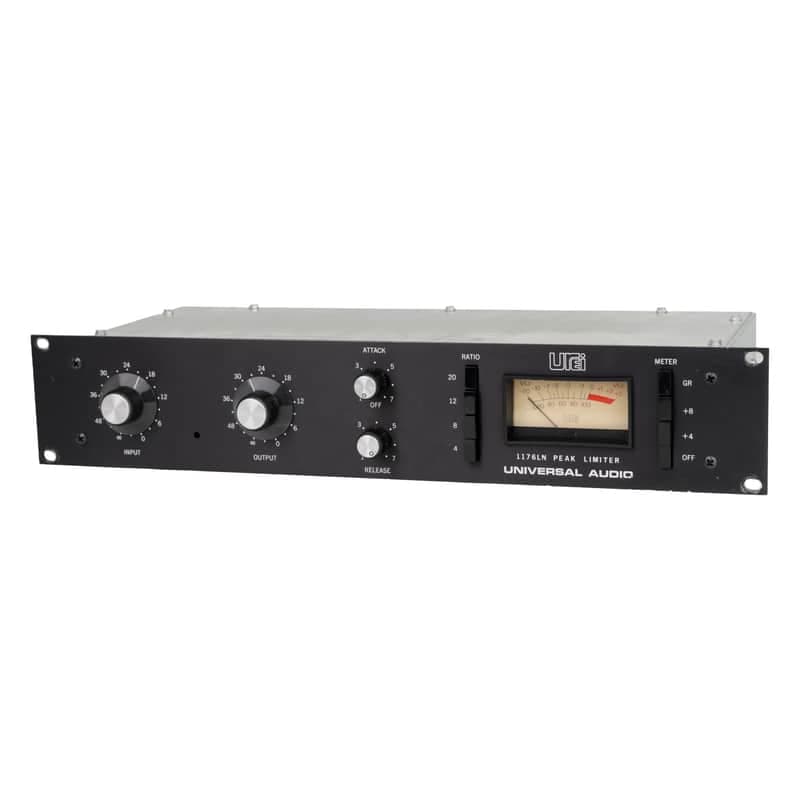
Urei 1176 LN Blackface Rev F Compressor/Limiter #4956 (Vintage)
£3,659
Price dropped from £3,672
Very GoodReverb1d ago
Sold by
V
Vintage King Audio
Details
- First Seen
- 25 November 2026
- Last Seen
- 27 November 2026
- Times Seen
- 4
About this listing
Urei 1176 LN Blackface Rev F Compressor/Limiter #4956 (Vintage) is a used item in very good condition, listed on Reverb. The asking price is £3,659. It is offered by Vintage King Audio through Reverb. It is in our Compressors & Dynamics category. Used Gear Hunter first saw this listing on 25 November 2026 and last saw it on 27 November 2026. It has been seen 4 times in our scans. Prices are converted from the seller's currency when we scan the listing, so the amount you pay may differ slightly. The seller sets shipping, and import duty or VAT may apply, so check the final cost and the item's details on Reverb before buying.
From the seller
VINTAGE KING APPROVED
This item has been carefully inspected, tested and serviced by our expert tech team. All vintage, used and open-box items we sell are backed by an industry-leading warranty. Expand your studio with confidence knowing that we have you covered.
Urei 1176 LN Blackface Rev F Compressor/Limiter #4956 (Vintage)
The Urei 1176 Compressor/Limiter was first introduced in 1967, created by Bill Putnam Sr. as the solid state successor to his tube-based 176 limiting amplifier. The 1176 uses a Field Effect Transistor, or FET, as a voltage divider to accomplish the task of compression, in conjunction with I/O transformers and a Class A line level amplifier. The 1176 was meant to be a ‘true peak limiter’ with a very fast attack of up to 20 microseconds, and lots of gain for a compressor - up to 45 dB.
The design of the unit went through numerous changes, taking a while to hit its stride. The originals were somewhat noisy, prompting Brad Plunkett of Urei to design the Low Noise circuit that gave the unit its ‘LN’ designation. Improvements continued to be made over the years, with the result that there are 9 major revisions of the vintage 1176, given the letters A, A/B, B, C, D, E, F, G, and H. The substance of these revisions is detailed below, gleaned from the Universal Audio website.
Based on the look of their faceplates, Revisions A, A/B, and B are all nicknamed the Bluestripe, since they all featured a section of blue paint around the VU meter. Revisions C to G all have the nickname Blackface for their black anodized aluminum, while the final Revision H is known as the Silverface, for its natural brushed aluminum. Most units include the revision letter with the serial number on the back. Revisions C, D and E (the first three with the LN circuit) are all very similar, and are historically the most beloved.
Despite the many design changes, all 1176 units have their basic features in common:
Input level control
Output level control
Threshold: dependent on input and ratio levels
Attack time: variable 20 µS microseconds to 800 µS microseconds
Recovery time: variable 50 mS to 1.1 sec
Compression Ratio: 4:1, 8:1, 12:1, 20:1, All-button
VU Meter
Meter select: Off, Gain Reduction, Output Level at +4 dBm or +8 dBm
Barrier strip I/O and 1176 SA stereo-link RCA jack on rear
1176 HISTORY
In essence, there have been only four basic versions of the 1176: the Bluestripes A, A/B and B; the Blackface LN’s C, D, and E, the higher output Blackface F, and the final G-H versions with op-amp inputs, in both black and silver faceplates. Check out our Pro Audio Hall of Fame to learn more about the history of the Urei/Universal Audio 1176LN Compressor/Limiter.
Revision A: Serial Numbers 101-125
The original 1968 design by Bill Putnam used an input transformer at the industry standard 600 ohms resistance (Peerless, later UTC), a T-pad resistive attenuator to drop the input voltage, a FET acting as a voltage variable resistor to control gain, followed by a bipolar transistor as a preamp (the famous 1108 circuit with a Darlington pair). The output amp circuit was similar to the preamp, but followed by a 2N3053 bipolar transistor operating in Class A. The output matching transformer at 600 ohms was a UA-5002 (later improved to UA5002A) with a split secondary, a tertiary winding for negative feedback to the final line output circuit, and a separate emitter winding. Covering up all this electronic wizardry was a brushed aluminum faceplate with blue paint around the Weston meter; two black plastic control knobs with silver tops and clear plastic collars; two smaller black and silver knobs; eight black plastic pushbuttons; and a red power indicator light. All the revisions to follow would maintain the same controls, but the red power light would disappear when the black faceplate was introduced.
Revision AB: Serial Numbers 125-216
A few short months after the initial version, an intermediate step was reached with some small improvements to the circuit and components. Resistor values were changed in the signal pre-amp stages, and bypass capacitors were added around the the resistor feeding the gain reduction FET. These changes improved noise and stability. All cosmetics remained the same.
Revision B: Serial Numbers 217-1078
The next year saw some more changes to the preamplifier circuit. The FETs were replaced by a 2N3391A bipolar transistor. Also, a tap off the emitter of the first transistor gave feedback of the input voltage back to the gain reduction FET. All cosmetics remained the same.
Revision C: Serial Numbers 1079-1238
In 1970 two major and two minor changes were implemented. Low Noise circuitry was added to the preamp stage in order to reduce the Drain-to-Source voltage of the gain reduction FET, keeping it within its linear range. This circuit was sealed in epoxy to keep it secret while a patent was pending. Also, a Q-bias pot was added to the feedback circuit of the audio FET, to minimize…