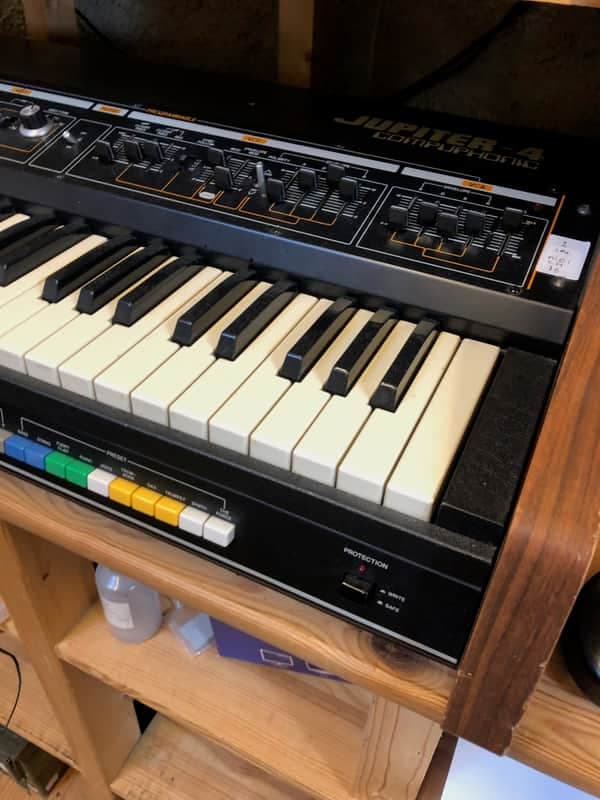
Roland Jupiter 4 49-Key Synthesizer 1978 - 1982 - Black is a used item in very good condition, listed on Reverb. The asking price is £3,929. It is offered by Vibey Studios Synths and Effects!!! through Reverb. Local pickup is available. It is in our Synthesizers category. 13 similar listings have a median asking price of £4,746. Used Gear Hunter first saw this listing on 1 October 2026 and last saw it on 22 November 2026. It has been seen 13 times in our scans. Prices are converted from the seller's currency when we scan the listing, so the amount you pay may differ slightly. The seller sets shipping, and import duty or VAT may apply, so check the final cost and the item's details on Reverb before buying.
From the seller
Its a Jupiter 4 ... really nice arpegiation function, sturdy and cuts through your mix!... this has MIDI and sounds great :)
Dutch auction
Woah! … slow down there mate…, steady your horses..I know what you are thinking !… x grand for poncey Moog!.. That is so expensive.. what this guy thinking?
What I’m doing is what I think is called a ‘Dutch Auction’!!
Simply put I’m starting high and each week I’m dropping the price until it’s sold… o if you want to see it at a reasonably come back in a while…BUT!… there is a chance that it will already be sold by then.. so keep an eye on it… and feel free to pm me with offers …
Here is an explanation of a Dutch Auction —>
A Dutch auction is a price discovery process in which the auctioneer starts with the highest asking price and lowers it until it reaches a price level where the bids received will cover the entire offer quantity. Alternatively, a Dutch auction is known as a descending price auction or a uniform price auction.
Or
A Dutch auction is one of several similar types of auction for buying or selling goods.Most commonly, it means an auction in which the auctioneer begins with a high asking price in the case of selling, and lowers it until some participant accepts the price, or it reaches a predetermined reserve price. This type of price auction is most commonly used for goods that are required to be sold quickly such as flowers, fresh produce, or tobacco.A Dutch auction has also been called a clock auction or open-outcry descending-price auction. This type of auction shows the advantage of speed since a sale never requires more than one bid. It is strategically similar to a first price sealed-bid auction.
History
Herodatus relates an account of a descending price auction in Babylon, suggesting that market mechanisms similar to Dutch auctions were used in ancient times.Descending-price auctions were used in 17th-century Holland for estate sales and paintings.The Dutch manner of auctioning appeared in England by the 17th century, which was called "mineing". In that type of auction, said to be a "Method of Sale not hitherto used in England", the auctioneer began with a high price that was sequentially reduced until one bidder cried out "Mine!”The Times mentioned one Dutch auction in 1788.