Back to Browse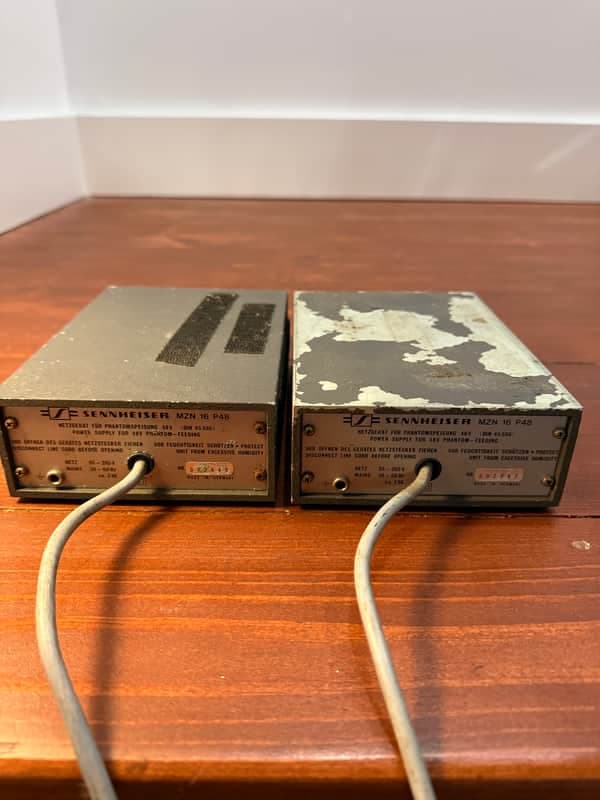
Sennheiser MZN 16 P48 (Two Units)
£180
GoodReverb1d ago
Sold by
G
Greg's Gear Garage
Details
- First Seen
- 24 October 2026
- Last Seen
- 25 October 2026
- Times Seen
- 3
About this listing
Sennheiser MZN 16 P48 (Two Units) is a used item in good condition, listed on Reverb. The asking price is £180. It is offered by Greg's Gear Garage through Reverb. It is in our Microphones category. Used Gear Hunter first saw this listing on 24 October 2026 and last saw it on 25 October 2026. It has been seen 3 times in our scans. Prices are converted from the seller's currency when we scan the listing, so the amount you pay may differ slightly. The seller sets shipping, and import duty or VAT may apply, so check the final cost and the item's details on Reverb before buying.
From the seller
Two Sennheiser MZN 16 P48. Both units work great and are clean sounding. 120 volt version. One unit has the grey paint chipping off.
The Sennheiser MZN 16 P48 is a vintage, standalone 48V phantom power supply manufactured in Germany during the 1970s. It was primarily engineered to power condenser microphones, particularly early iterations of Sennheiser’s high-end MKH series (like the legendary MKH 416)
Magnetic Shielding: It is built with two internal mains transformers strategically aligned to compensate for and counteract magnetic stray fields. This layout ensures the power supply doesn't introduce unwanted hum or interference into nearby audio cables.
Universal AC Input: According to the Sennheiser MZN 16 P48 User Manual, the hardware utilizes a double-insulated design that operates without a voltage selector switch on AC lines anywhere between 95V and 265V.
Short-Circuit Protection: The device does not use standard internal fuses because its dual transformers and audio outputs are entirely short-circuit proof.
How it Handles Your Signal:
Power Injection: It sends 48V down the XLR cable to power the internal electronics and capsule of a condenser microphone.
Audio Transparency: The audio signal passing through the unit is completely untouched. It does not boost the volume, change the impedance, or add any gain to the microphone's output.