Back to Browse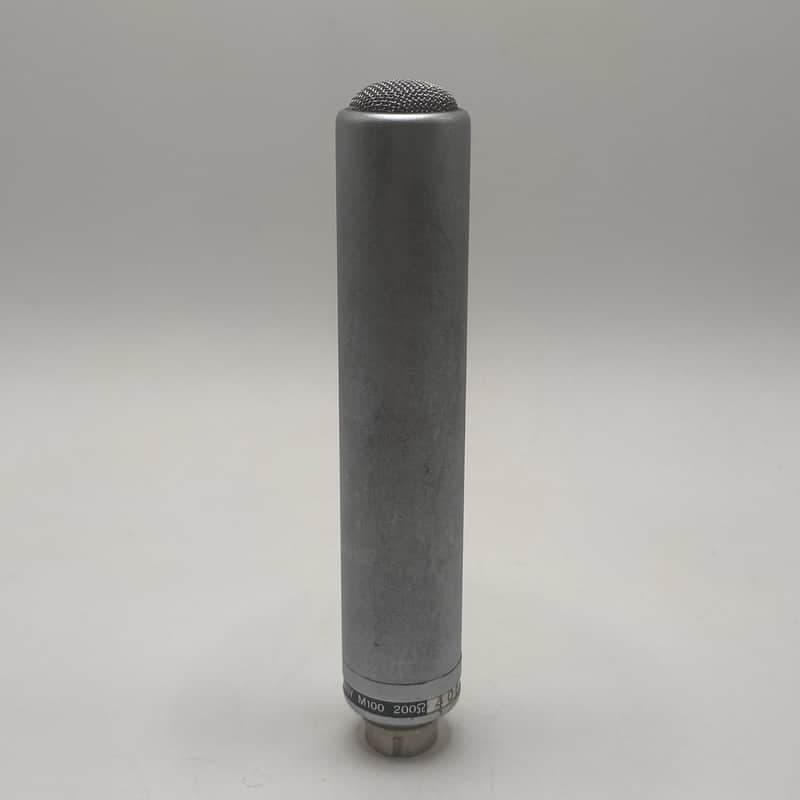
Beyerdynamic M100 1956 - Historical Omnidirectional Dynamic Microphone
£508
ExcellentReverb1d ago
Sold by
M
Micster
Details
- First Seen
- 24 October 2026
- Last Seen
- 25 October 2026
- Times Seen
- 3
About this listing
Beyerdynamic M100 1956 - Historical Omnidirectional Dynamic Microphone is a used item in excellent condition, listed on Reverb. The asking price is £508. It is offered by Micster through Reverb. It is in our Microphones category. Used Gear Hunter first saw this listing on 24 October 2026 and last saw it on 25 October 2026. It has been seen 3 times in our scans. Prices are converted from the seller's currency when we scan the listing, so the amount you pay may differ slightly. The seller sets shipping, and import duty or VAT may apply, so check the final cost and the item's details on Reverb before buying.
From the seller
A MASTERPIECE OF GERMAN MICROPHONE ENGINEERING
Omnidirectional Dynamic Microphone
The Beyerdynamic M100 is a fascinating example of early German microphone engineering, dating from an era when manufacturers were pushing the technical boundaries of what a moving-coil microphone could achieve.
Introduced during the 1950s, the M100 was an exceptionally compact, high-quality omnidirectional dynamic microphone, developed for demanding professional audio applications.
What makes the M100 especially remarkable is its original published frequency response of 40 Hz to 18,000 Hz, with a tolerance of just ±2.5 dB — an impressive technical achievement for a miniature dynamic microphone of the early 1960s. also one of the most iconic design of minimalism - and a very limited production.
Its appeal lies not only in its relative scarcity but also in its unusual engineering concept: a miniature omnidirectional moving-coil microphone offering a frequency response more commonly associated with professional condenser designs.
Today, the M100 is a seldom-encountered historical microphone, representing an interesting chapter in Beyerdynamic's development.
OPTICAL CONDITION
Good Vintage Condition
The microphone displays normal signs of age and use, consistent with its approximately six decades of history. the front mash shows minute disformations
original appearance is preserved.
Please examine the photographs for a detailed impression of its cosmetic condition.
TECHNICAL CONDITION
Fully Functional
in this example - the bass roll starts below approximately 75 Hz when compared which is higher when compared with the 1963 factory specifications we found. this slight deviation does not mean a defect/ in fact the microphone satisfies test on fq reach of 50 and above 18khz as well as sensitivity of - 80db 01mv bar at 1000hz.
It retains its six-pin small Tuchel connector, a connection format specifically offered as a factory option in Beyer's original 1963 documentation.
The microphone is therefore in original technical state - and close with the microphone's original spec .
CONNECT TO XLR
We have a very limited amount of small 6 pin Tuchel connectors -
adapters cables to XLR Can be made upon request to desired length.
provided together and wired especially for this microphone
Please contact for further details.
FACTSHEET / TECHNICAL SPECIFICATIONS
Manufacturer: Beyerdynamic / Eugen Beyer
Model: M100
Country of Manufacture: West Germany
Production Period: Introduced in the 1950s; documented in the 1963 Beyer catalogue
Microphone Type: Dynamic moving-coil microphone
Polar Pattern: Omnidirectional (Kugel)
Frequency Response: 40 Hz – 18,000 Hz (original factory specification)
Frequency Response Tolerance: ±2.5 dB (original factory specification)
Sensitivity: 0.1 mV/µbar at 1 kHz (−80 dB)
Nominal Impedance: 200 Ω
Dimensions: 22 × 120 mm
Weight: 115 g
Optional Factory Connector: 6-pin Beyer T 3402
Connector on This Example: 6-pin small Tuchel
Serial Number: 4056
Historical Documentation: Original Beyer M100 technical brochure, March 1963
BUILD & DESIGN — A STUDIO MICROPHONE IN MINIATURE
The M100 was not simply another general-purpose dynamic microphone.
Its design reflects the increasingly sophisticated requirements of professional audio engineering in postwar Germany, particularly in broadcasting, recording and sound reproduction.
One of its most striking achievements was miniaturisation.
Measuring just 22 mm in diameter and 120 mm in length, the M100 approached the proportions of contemporary small-diaphragm condenser microphones while employing an entirely different transducer principle.
Achieving such an extended and remarkably linear frequency response from a compact moving-coil assembly was a significant engineering accomplishment for its time.
The original Beyer documentation from March 1963 specifies a frequency response extending from 40 Hz to 18,000 Hz, with deviations of only ±2.5 dB.
Even by modern standards, these are ambitious published specifications for a miniature dynamic microphone.
The original frequency-response graph illustrates a particularly even response throughout the central frequency range, with relatively modest variations extending well into the upper frequencies.
Unlike directional microphones, the M100's omnidirectional pressure transducer does not exhibit the conventional proximity effect, making it particularly suitable for applications where a natural and consistent tonal balance is desirable.
Its small dimensions, broad frequency response and unobtrusive construction made it a technically sophisticated solution for professional recording and broadcasting applications.
A PLACE IN BEYERDYNAMIC HISTORY
The M100 belongs to an important period in the development of German professional microphone technology.
Following the destruction of its Berlin factory during the Second World War, Eugen Beyer re-established production in Heilbronn in 1948.
During the…